

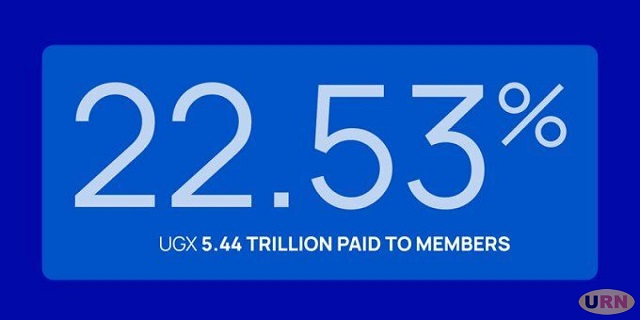
Kampala, Uganda | URN | The announcement that NSSF member-savers will earn a record 22.53 percent interest on their savings has been greeted with excitement.
Savers in the contributory pension schemes are set to receive 5.44 trillion shillings in interest for the financial year 2025/2026.
The excitement aside, the unusually high return is raising questions about its potential impact on the country’s wider savings and investment industry, particularly unit trusts, voluntary retirement schemes and government securities.

The 22.53 percent rate is significantly higher than the returns currently offered by many competing savings and investment products.
For savers, the question is whether products offering lower returns can continue to attract money when the country’s largest social security fund has demonstrated that it can deliver a return above 20 percent in a single year.

At the NSSF Annual Members Meeting on Thursday, some savers said the announcement had already forced them to reconsider where they should put their money.
One of them, Kristian, a saver with MTN, said he had been considering moving some of his savings into NSSF’s SmartLife Flexi voluntary savings product because he expected its return to remain broadly comparable to the main NSSF scheme.
But the 22.53 percent declared on the main fund has changed his calculations.
“I joined Smart Life because I was told the interest would be the same as the main NSSF annual rate, so I was planning to get some money from there to Smart Life, which gives 13, 14 or 15 percent. But now with this 22.53 percent, I’m confused,” he said.
Kristian’s dilemma reflects a broader challenge for savings products competing for Ugandans’ money.
NSSF and the Uganda Retirement Benefits Regulatory Authority, URBRA, have previously acknowledged the growing role of unit trusts in mobilising savings, including money accessed by members through NSSF’s midterm access arrangements.
Unit trusts have attracted savers partly because they provide relatively competitive returns while allowing investors easier access to their money.
Returns of about 11 to 13 percent have been common among some of these products, putting them in competition with NSSF, which declared 13.5 percent interest for 2024/2025.
The 22.53 percent payout therefore creates a much wider gap. Gerald Kasaato, the NSSF Deputy Managing Director, however, cautioned savers against making investment decisions based solely on the return declared in a single year.
He said NSSF’s SmartLife Flexi has advantages of its own, including a more predictable return, while the return on the main NSSF fund can fluctuate depending on investment performance.
Kasaato advised savers to diversify their investments by spreading their money between short-term products such as unit trusts and longer-term retirement savings.
Managing Director Patrick Ayota similarly cautioned against concentrating savings in one investment product.
While putting money into a single product may generate higher returns when that product performs exceptionally well, Ayota said diversification helps spread investment risk.
The 22.53 percent return is based on a year in which NSSF’s overall financial performance was exceptionally strong.
The Fund’s assets under management increased from about 26 trillion shillings to 32 trillion shillings, while annual revenue rose by 86 percent to Shs6.51 trillion.
Member contributions increased by 13 percent to 3.4 trillion shillings. The question for the market is therefore not simply whether other financial products can match 22.53 percent, but whether such a return can be sustained by NSSF and what happens to savers’ expectations if it cannot.
Bernard Oundo, former president of the Uganda Law Society, describes the development as a potential market disruptor.
“If NSSF can sustain returns at this level, it could significantly reshape Uganda’s savings and investment landscape. Unit trusts, government bonds and other savings products will face greater pressure to compete for investors’ money,” he says.
Government securities have traditionally provided one of the more established investment avenues for Ugandan savers and institutional investors.
Government Treasury bills have recently offered returns in the range of about 9.75 to 11 percent, while medium- and long-term Treasury bonds have offered roughly 14 to 17.5 percent.
Real estate, another major investment option, has commonly generated returns estimated at between 12 and 15 percent, depending on the property and investment strategy.
Against this background, the NSSF declaration has established a new reference point for savers, even though the products are not directly comparable in terms of liquidity, risk, investment horizon or how returns are determined.
Alex Kakande, a Certified Financial Analyst, had predicted that NSSF could declare an interest rate of around 20 percent, based on the Fund’s strong financial performance during the year. At the time, the prediction was widely treated with scepticism.
Following the 22.53 percent declaration, Kakande says NSSF has now created a very high benchmark for its own future performance.
“The pressure is going to be real. Fund managers will be watching. Savers will be watching. Ugandans will be watching. Every member will now look at that 22.53% and ask what happens next year,” he says.
Kakande says the declaration could also change how Ugandans think about retirement savings.
“We could potentially see more people asking themselves whether NSSF SmartLife and other NSSF products should form a bigger part of their long-term savings strategy. The conversation around retirement savings in Uganda has just changed,” he says.
The immediate question for competing fund managers is whether they can offer higher returns without taking on significantly greater risks. For NSSF, the challenge is different.
A 22.53 percent return may strengthen confidence in the Fund and encourage more savings, but it also raises expectations among members who may begin to regard this year’s exceptional return as a benchmark for future payouts.
The Fund will therefore have to balance the competing demands of delivering attractive returns, managing investment risks and maintaining confidence in the long-term sustainability of members’ savings.
For Uganda’s savings industry, meanwhile, the significance of the announcement may extend well beyond the 5.44 trillion shillings being credited to NSSF members this year.
It could influence where households, workers and investors choose to put their money, how competing financial products price their returns, and the level of competition for the country’s growing pool of savings.