

Two decades of progress provide a platform for Uganda’s next agricultural leap

Kampala, Uganda | RONALD MUSOKE | Uganda must do more to ensure agricultural innovations developed by scientists reach farmers if the country is to translate its vast agricultural potential into higher incomes, jobs and food security, stakeholders have said.
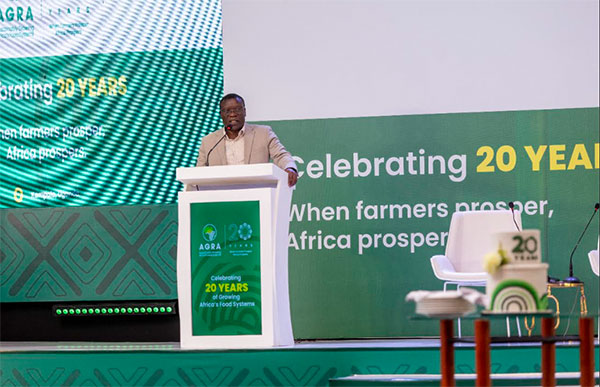
The call was made during the AGRA@20 Uganda Country Celebration held at Kampala Serena Hotel, where government officials, researchers, farmers’ organisations, private sector players and development partners reflected on two decades of progress in Uganda’s agricultural sector while charting priorities for the years ahead.
Speakers at the July 10 national dialogue stressed that stronger agricultural extension services, coordinated investment, competitive markets and increased value addition will be critical if Uganda is to build a resilient agrifood system capable of meeting domestic and regional food demand.

Bridging the research-to-farm gap
Opening the dialogue, David Wozemba, the AGRA Country Director said the organisation’s experience over the past two decades had demonstrated that Africa’s agricultural transformation must be driven by African institutions, scientific innovation and locally developed solutions. He noted that stronger collaboration among research institutions, government, the private sector and development partners would be essential in making food systems more productive, inclusive and resilient.
Dr Patience Rwamigisa (PhD), the Commissioner for Extension Coordination at the Ministry of Agriculture, Animal Industry and Fisheries (MAAIF), said Uganda already possesses a strong agricultural research system but continues to struggle with transferring technologies from laboratories and research stations to farmers. “We have a strong agricultural research system. However, how do we move those technologies beyond research institutions and into farmers’ fields?” Rwamigisa asked.
He called for increased investment in agricultural extension services and stronger partnerships among universities, research institutions, government agencies and development organisations to ensure farmers have access to improved technologies and knowledge.
Rwamigisa also urged better coordination of public and development partner investments to reduce duplication and address critical gaps within the agricultural sector. He pointed to the Parish Development Model (PDM), through which approximately Shs1.3 trillion is being channelled directly to communities, as an opportunity to organise production, strengthen agriculture at parish level and improve farmer productivity. He further emphasised the importance of investing in soil health, sustainable land management and climate-smart agriculture to enhance resilience against climate change.
Two decades of impact
AGRA began working in Uganda in 2006, initially focusing on strengthening national agricultural research capacity. Over the past 20 years, the organisation has supported the training of 49 master’s and 20 doctoral graduates in plant breeding and soil science. Their research contributed to the release of 59 improved crop varieties, 56 of which have since been commercialized, providing farmers with better-performing seeds suited to local conditions.

Beyond research, AGRA says its programmes have reached more than 427,800 farmers with information on value chains, mechanized farming services, crop insurance and market prices. The organisation has also supported the establishment of seven seed companies, expanded national seed inspection and certification systems, and worked with partners to improve farmers’ access to quality seed and crop-specific fertiliser blends.
In agricultural marketing and finance, AGRA has facilitated the construction and rehabilitation of 440 aggregation centres to strengthen post-harvest handling and market access. It also helped small and medium-sized agribusinesses generate more than US$21 million in regional grain trade over a three-year period. Its interventions further leveraged US$62.8 million in investment for agribusiness enterprises, while credit guarantee schemes unlocked US$25 million in agricultural lending, benefiting more than 50,000 farmers.
Next phase: Markets, value addition and jobs
Looking ahead, AGRA’s Uganda Strategic Plan 2024–2028 seeks to strengthen inclusive and competitive agricultural markets, improve quality seed systems, promote sustainable farming and reinforce policy and institutional capacity.
The strategy focuses on improving the competitiveness of maize, beans and rice while supporting value addition and regional trade in other priority commodities, including soybeans, cassava, sorghum and groundnuts. The plan aligns with Uganda’s broader ambition of building a modern agribusiness economy that promotes food security, export growth, import substitution and employment while taking advantage of growing regional demand for food.
Participants at the anniversary dialogue identified three priorities that should shape Uganda’s next phase of agricultural transformation: increasing agricultural production and productivity; expanding inclusive markets and trade to improve farmer incomes through value addition; and strengthening public institutions and policy implementation to build resilient agrifood systems.


Building partnerships for the future
The dialogue also explored the partnerships Uganda will require over the next two decades to position itself as one of Africa’s leading food producers. AGRA said it would continue supporting the Government of Uganda in implementing national and continental agricultural priorities, including the Comprehensive Africa Agriculture Development Programme (CAADP) Strategy and Action Plan 2026–2035, strengthening seed systems and advancing climate resilience.
Emerging partnerships include the Agrifood System Transformation for Youth Employment programme with the Mastercard Foundation and collaboration with the World Bank on agricultural trade and data systems. As AGRA celebrated two decades of work in Uganda, participants agreed that the country’s agricultural future will depend not only on generating new technologies, but also on ensuring they reach farmers, attract investment, create competitive markets and ultimately improve rural livelihoods.
The post Uganda urged to bridge research-to-farm gap as AGRA marks 20 years of agricultural transformation appeared first on 1:.