

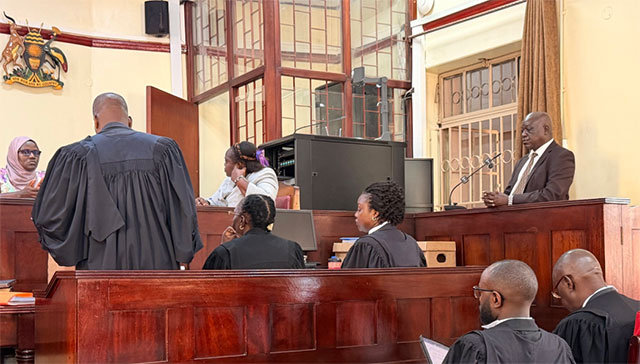
Dr Onzivua explained to the court the forensic principles used to identify gunshot entry and exit wounds, with the defence maintaining that the State’s interpretation was scientifically wrong.

Kampala, Uganda | NEWS CORRESPONDENT | The trial of businesswoman Molly Katanga entered a new phase at the criminal division of the High Court as the defence opened what is expected to be a fierce battle between its expert witnesses and prosecutors.
On Monday, May 11, 2026, Katanga concluded her testimony after prosecutors completed cross-examination and her lawyers conducted a brief re-examination to clarify issues raised during questioning.
The scientific evidence presented by prosecutors has faced close scrutiny as Molly Katanga pushes back against what she has described in her sworn testimony as “conspiracy” and “framing”.
During the proceedings before Justice Rosette Comfort Kania, prosecutors Samali Wakooli, Jonathan Muwaganya, and Anna Kiiza suggested that Katanga killed her husband, businessman Henry Katanga, to gain control of company accounts and take over family property.
The prosecution presented bank records showing Katanga continued transacting on company accounts after her husband’s death.

However, Katanga rejected the claim and told the court she had been operating those accounts herself since 2004.
She also dismissed allegations that she killed her husband to gain access to property.
According to the defence, Katanga told prosecutors that many of the properties discussed during the trial had actually been purchased using her own money before being jointly registered with her husband.
She referred to an earlier prosecution claim that a property purchase agreement was the motive for the alleged killing because investigators believed she wanted Henry Katanga to sign it. Katanga responded that she had already purchased, paid for, and signed the agreement herself.
She accused police investigators of fabricating evidence and framing her.
“What I told you, that’s what exactly happened. I was framed. Who can’t see that? I was framed by police, by schemers. I was framed. How could I kill with such injuries that you have seen? They say I fabricated. What did I fabricate? I did not,” Katanga told court.
Much of her defence is focused on forensic evidence.
Katanga questioned how prosecutors could rely on DNA findings in January 2024 when, according to testimony in court, the forensic results only became available months later, in April 2024
“Where you charge someone in January based on the results that came later in April, what is that?” she asked.
She also questioned the handling of gunshot residue tests, arguing that samples allegedly exhausted during DNA analysis later appeared in separate forensic reports.
Enter Dr Sylvester Onzivu
Thursday, the defence called renowned forensic pathologist Dr Sylvester Onzivua, who challenged the state’s interpretation of Henry Katanga’s gunshot wounds.
According to the defence, what prosecution witnesses described as the bullet entry wound may actually have been the exit wound, while the alleged exit wound could have been the entry point.
The defence argues that this distinction is important because prosecutors had earlier suggested that Henry Katanga was shot on the left side of the head, something they argued would have been difficult for a right-handed person to do to himself.
Dr Onzivua explained to the court the forensic principles used to identify gunshot entry and exit wounds, with the defence maintaining that the State’s interpretation was scientifically wrong. Dr Onzivua was the first defense witness in this trial.
In one of his concluding presentation slides, Dr Onzivua invoked the “duck test”, telling the court: “If it looks like a duck, swims like a duck, and quacks like a duck, then it probably is a duck,” before concluding that, in his opinion, the case pointed to what he described as “homicide suicide”.
Police Director of Health Services Dr Moses Byaruhanga had earlier testified, as a state witness, that Molly Katanga suffered severe injuries, including broken bones, blunt force trauma, deep tissue bleeding, and head wounds that he described as potentially life-threatening without urgent medical intervention.
The prosecution suggested some of the injuries may have been self-inflicted or exaggerated.
On her first day of her testimony, Molly Katanga removed the covering on her head to show scars on her head from the injuries she suffered during a domestic dispute on the morning of her husband’s death.
The trial continues before Justice Kania as defence presents new insights on what exactly happened inside the Katanga residence in Mbuya on the morning Henry Katanga died.