

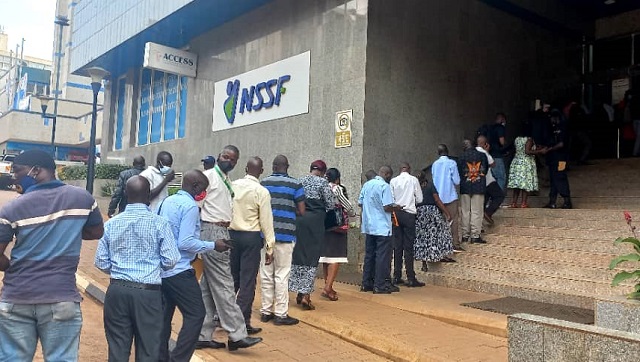
Many retirees, burdened with dependents, find themselves continuing to work, with 63% of beneficiaries still employed
Kampala, Uganda | JULIUS BUSINGE | The National Social Security Fund (NSSF) Beneficiaries Survey Report for 2023, conducted in collaboration with Enterprise Uganda, exposes a glaring insufficiency in the country’s retirement benefits, with an average payout of Shs24 million to beneficiaries, whose average age stands at 50 years.
Alarmingly, 60% of recipients received less than Shs 10 million, and a disproportionate 83% of the fund’s value was distributed among merely 25% of the beneficiaries. This disparity signals the pressing need for beneficiaries to gain financial literacy to extend the lifespan of their benefits effectively.

The report further reveals the primary uses of NSSF benefits, with education, land purchase, home construction, and business investments leading the way.
Releasing the report on March.21 in Kampala, NSSF Managing Director, Patrick Ayota, emphasized the indispensable role of entrepreneurship and financial literacy, cautioning against the potential pitfalls of ill-advised business ventures upon receiving the payouts.
Concerningly, 44% of beneficiaries who invested chose to venture into new businesses, typically receiving lower payouts and, by extension, possibly possessing lower educational levels.

These investment choices suggest a cautious approach among those with higher payouts, who preferentially select less risky financial products, evidencing a knowledge gap in financial instruments among the less educated. The average investment into new businesses was noted at Shs6.2 million, indicating a trend towards micro or small enterprises.
The survey outlined a clear preference for spending on home improvements, education, land acquisition, and business expansion, with most beneficiaries unlikely to alter their spending priorities. Pre-planned spending accounted for 85% of the expenses, revealing a significant level of financial planning among the beneficiaries.
Female vs male savers
However, the survey highlighted a stark gender disparity among savers, with females making up only 23% of beneficiaries, reflecting historical formal employment trends in Uganda. Despite a slight improvement in gender coverage within current membership statistics, the gap remains substantial.
Many retirees, burdened with dependents, find themselves continuing to work, with 63% of beneficiaries still employed. Yet, business income remains a minor survival strategy for the surveyed retirees, with only 18% relying on it.
The readiness to receive benefits showcased a split view, indicating a strong desire for the benefit, though not necessarily correlating with proper fund utilization. Moreover, the survey pointed out the high dependency rate among beneficiaries over 45, with a significant portion of their benefits going towards non-income-generating household expenses.
Low awareness of the NSSF’s financial literacy programs, especially outside Kampala and the Central region, calls for an expansion of these initiatives to reach more beneficiaries nationally. Of those who participated in financial literacy programs, a significant majority found them beneficial, advocating for the scaling of targeted educational efforts.
Interestingly, a majority of beneficiaries did not seek advice before or after receiving their benefits, relying instead on personal experience or prior planning. This attitude toward professional advice suggests a potential barrier to the effectiveness of financial literacy programs.
The report concludes with a critique of the cycle of dependence perpetuated into retirement, with beneficiaries exhausting their funds on dependents, thereby continuing a cycle of financial insecurity. This cycle underscores the necessity for enhanced education on financial planning and investment to ensure beneficiaries can sustain themselves through retirement more effectively.
The post NSSF payouts insufficient for retirement-survey appeared first on The Independent Uganda:.