

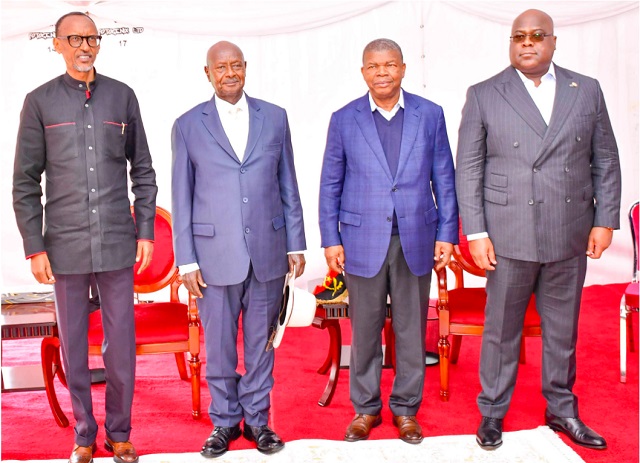
How politics in Kinshasa has united with interests in the “international community” to sustain Congo as a failed state
THE LAST WORD | Andrew M. Mwenda | Rwanda is a very unlucky country. It is the most developmentalist state in Africa. Yet its ambitions to modernise do not depend entirely on its own politics and the decisions of its leaders. They also depend (and to a very large degree) on the politics and decisions of its neighbours and those of the “international community” (read Western powers). Oxford economist, Paul Collier, published research showing up to 2% of a country’s GDP growth comes from GDP growth of its neighbours. Hence, Rwanda is stuck in a bad neighbourhood. And it can do very little about it because as a country, Rwanda can choose its friends but not its neighbours.
Look at Rwanda’s neighborhood: to its West is DRC, 88 times larger than Rwanda in land area and the archetypal failed state. To Rwanda’s south is Burundi, another failed state. Both countries have suffered slow, stagnant and often negative economic growth for decades. Here Rwanda is unable to reap what economists call “positive externalities” – the spillover effects of growth of its neighbours. To Rwanda’s north and east are Uganda and Tanzania, which have been growing well and thereby adding to Rwanda’s growth. But because Rwanda is landlocked, the infrastructure decisions of Uganda (and beyond it, Kenya) and Tanzania have powerful implications on the cost of Rwanda’s access to the sea.

Therefore, whatever President Paul Kagame and his confederates in Kigali do, they often find their ambitions thwarted by the politics and decisions of the neighbours. One particular example is Congo and M23. Although M23 is primarily a domestic problem of Congo, its concerns and interests have powerful implications on politics inside Rwanda. There has been a convergence of different but compatible interests between Congo and the international community (read the West) in how to shape the narrative about M23. They all present M23 as a Rwandan problem.
Congo is, particularly in its eastern regions, an absentee state. There is a tragic lack of even rudimentary administrative state infrastructure to perform such basic functions like maintaining law and order. The country is host of more than 500 ethnic groups. Then it has rich natural resources. Ethnic communities compete for these resources and fight over them. Without a functional state to ensure order, every ethnic community creates its own militia to defend its interests. Consequently, there are more than 200 “rebel groups” in Congo. These fight among themselves and sometimes the Congolese state. Yet at other times these militias, depending on the circumstances, also work with and for Kinshasa.
After the 1994 genocide, those who had committed mass murder in Rwanda found sanctuary in Congo. This was largely because of the complicity of Kinshasa but also partly because of its incompetence. They formed the FDLR rebel group. This Hutu extremist militia plans to return to Rwanda and commit yet another genocide. For now, they cannot try because Rwanda is too powerful. But there are ethnic Tutsi communities in eastern DRC. FDLR’s ideology is to exterminate them. In this ambition it finds support from some other ethnic communities inside Congo and in the Congolese state. M23 was born to protect ethnic Tutsi from the FDLR, the depredations of the Congo state and malign intentions of other ethnic communities.

Therefore, M23 has legitimate grievances that Kinshasa and the so-called international community need to take seriously. But they don’t. Why? For Kinshasa, it’s politics. A narrative has been created in Congo that Rwanda seeks to occupy and steal its mineral riches. Hence, for a politician to win presidential elections in that country, they have to present themselves as the vanguards of Congolese sovereignty against Rwandan aggression. It is no wonder that hostilities between Kinshasa and Kigali always reach fever pitch as Congo nears elections. The next Congo election is this year.
And Kigali cannot avoid issues in the Congo. For as long as FDLR finds sanctuary there, Kigali has a serious security interest in Congo. And because FDLR is a group seeking genocide against Tutsi’s, Kigali cannot be a disinterested party. First because Kigali and M23 face a common enemy, FDLR. But second because the legitimacy of the current state and government of Rwanda is in no small part derived from their role in ending the genocide against Tutsis inside Rwanda. Today, Tutsis form a powerful influence in the government in Kigali. There is no way any group can organise a genocide against Tutsis in the DRC (or any neighbour – Burundi, Tanzania and Uganda) and Kigali remains disinterested.
We have explained why Congolese politicians find it in their interest to whip up anti-Rwandan sentiments. But why does the international community (the West) join Kinshasa’s anti-Rwandan choir? Powerful business interests in the West see Congo as their cake to bake and eat. They don’t want anyone poking their nose there. Behind these are the international human rights mujahedeen, supported by an international press corps who provide intellectual justification for these business interests. It is these latter groups that have actively created a narrative that DRC is a victim of Rwandan aggression. In the process they have played down or completely ignored the genocidal intentions of FDLR and its backers in Kinshasa.
The resolution of the Congolese question has to begin from the fact that Congo is a failed state. Its inability to exercise effective (or even rudimentary) control over its territory creates risks for its own people and her neighbours. Therefore, both Rwanda and M23 are victims of the crisis of the state in Congo. However, Rwanda can play an important role in the resolution of this problem. This is largely because, unlike the international human rights mujahedeen, Kigali has a big stake in the stability of Congo.
The chaos in Congo threatens Rwandan security. Congo’s slow, stagnant or negative economic growth undermines Rwanda’s growth ambitions. Therefore, Kigali can become an important partner with the region, the international community and Kinshasa in helping create stability in the east. But this requires a leader in Kinshasa who is not going to play populist politics. Sadly, I do not see where and how this leader will emerge given the internal elite narratives and the ease with which the Rwanda boggy wins popular support. It also requires the east African region and the international community to insist that Congo lives up to its responsibilities. Again, I do not see Western interests helping in this since it seems they profit by the confusion and chaos in Congo. That is the tragedy!
*****
amwenda@independent.co.ug
The post Rwanda, DRC and M23 appeared first on The Independent Uganda:.