

Target is to create 500 startups, up to 20,000 jobs by the year 2028
 Support 500 startups
100 startups to scale
Create132,000 jobs
132,000 new NSSF members
Use $10million

 In the past 14 months
8,039 entrepreneurs have gone thru the NSSF academy
110 businesses have qualified for funding in last 12 months
20,975 direct & indirect jobs will be created
Kampala, Uganda | LOUIS JADWONG | The National Social Security Fund (NSSF) Hi-Innovator initiative that is supporting small and growing businesses, could help create up to 132,000 new Ugandan jobs by 2028.

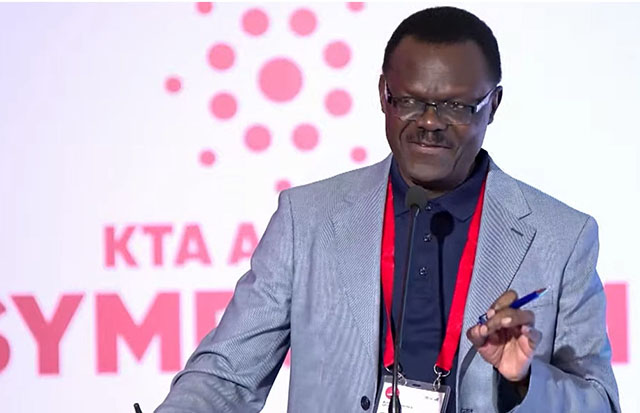
“Instead of us waiting for people to come to save with NSSF, we aim to give people ability to save and create jobs. We noticed startups have the highest potential of creating jobs,” said Patrick Ayota, NSSF Deputy Managing Director at the 5th KTA Annual Symposium on Intellectual Property and Technology held at Speke Resort Munyonyo in Kampala this week.
The symposium was tailored under the theme; Achieving Uganda’s NDPIII Goals; How Intellectual Property, Digital Trade and 4IR can facilitate an inclusive and robust digital economy.
According to the NSSF Deputy Managing Director, one of the main incentives for putting together a $10million Hi-Innovator fund is that by investing in Ugandan startups, they will also create 132,000 new members. NSSF currently has 800,000 active members.
“This country is not creating enough jobs. We are supposed to create 600,000 jobs a year, but we are currently at 90,000. When we did projections to 2045, we noticed NSSF would be dying out unless we intervened and did something in terms of creating jobs, and in the process create new members for our own future.”
Ayota added that, “in our projections going up to 2040, we realised our earnings were coming from two places; by making more money through revenue, and do not use it all, and new contributions that come from higher salaries or new members.”
The NSSF Hi-Innovator seeks to give visibility to small and growing businesses so as to help them secure seed funding, receive technical assistance and
The pilot stage
He said whereas whoever has ideas can easily get funding in Uganda, the pilot stage of development of startups has virtually no support, which explains why many startups do not survive after the first few years.
Ayota revealed that research shows that 75% of startups in USA die within the first 5 years. The statistic for Uganda, he said, is belived to be about 90%, thus the reason NSSF has decided to intervene.
“The biggest problem is few investors put money into the pilot stage for startups, so all the good ideas die,” he remarked.
“As NSSF, we are going to intervene in the pilot stage. We borrowed an idea from the Y Combinator, a Silicon Valley company that put $25,000 into US startups to go through the pilot stage.”
VIDEO DAY 2
The Hi-Innovation fund
The NSSF incubation fund to support young innovators is already supporting 110 businesses since it was launched last year. The fund also aims to support women-led startups, and will in November 2022 pick winners.
The fund, made up of $5million each from NSSF and Mastercard Foundation, aims to build the capacity of entrepreneurship, by providing quality technical assistance and work with financing institutions to unlock affordable capital to make startups become more competitive.
Each year, from last year, $2m will be spent on supporting startups scale their business. In order to help the companies survive, NSSF and Mastercard invest $20,000, and later will invest (take shares) between 6%-7% in each of these companies.
The Hi-innovator initiative is supporting small and growing businesses by extending catalytic seed funding, building the capacity of entrepreneurship support organizations to provide quality technical assistance and working with financing institutions to unlock affordable patient capital so that they can become more competitive.
NSSF works with Entrepreneurship Support Organizations and Investors to ensure that entrepreneurs establish high impact, sustainable businesses that can be scaled.
Ayota hailed KTA Advocates for providing free legal services to young innovaters in their programme.

Case for intellectual property
Earlier, Edgar Tabaro, partner of KTA Advocates, called for government to commoditize intellectual property and support innovation.
“The biggest earnings for the US, come from music, tech (apps) and movies. These are creations of the mind (IntellectualProperty). Our biggest challenge is we have failed to mainstream intelectual property in our development processes,” Tabaro said.
He added that, “creations of the mind do not require a lot of capital. You do not need a square mile of land or billions of shillings to do coding, to create brands, to compose music, or even for movies.”
Tabaro reitereted that fact tha KTA Advocate provides free legal services to innovators. “Many times, when young innovators want to take their idea to the next level, they lack funds to register companies and apply for protection of them.
The 5th Annual Symposium on Intellectual Property and Technology is organised by KTA Advocates (formerly Karuhanga, Tabaro & Associates) in collaboration with United Nations Capital Development Fund (UNCDF). The two-day symposium hosted speakers, panelists, government officials, economists, lawyers, representatives from civil society organizations, finance and planning sector and academicians.
Prof Ezra Suruma represented President Yoweri Museveni and officially opened the symposium. Other key invited speakers included Anthony Taubman, the Director World Trademark Organisation IP Division and Mike McCaffrey – Manager UNCDF for East & Southern Africa – Region.

This symposium aimed to facilitate dialogue between policymakers, regulators and relevant stakeholders to discuss how technology and intellectual property can be harnessed to realize the objectives under the NDP III. It aimed to avail members and regulators in the technology and innovation sector with a platform to discuss the salient issues that affect the sector and how these can be addressed through legislation or policy.
Other partners for this year’s symposium included Uganda Law Society Uganda (ULS), NBS TV and East African Law Society. Sponsors for the event are Huawei Technologies (U) LTD, Equity Bank (U) LTD, E-Trade & Startup Association of Uganda (Jumia & Safeboda), Gikera & Vadgama Advocates, Mawalla Advocates, Youth Startup Academy Uganda, Citizen Report and Big Conversations, Ordinary People.
VIDEO DAY 1
The post NSSF and Mastercard invest $10m in Ugandan ‘Silicon Valley’ appeared first on The Independent Uganda:.