

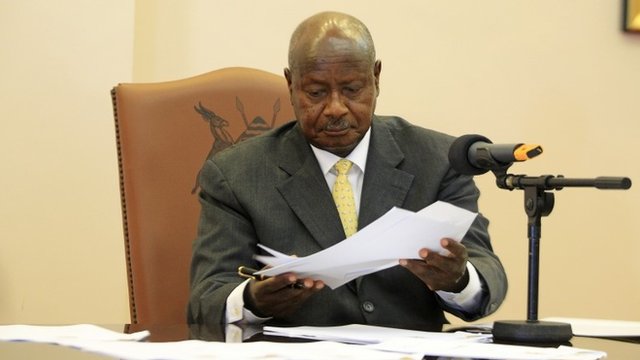
People involved in killing people for rituals will now face life imprisonment after President Museveni assented to Prevention and Prohibition of Human Sacrifice Act, 2021.
The revelation was made by Former Ayivu County Member of Parliament Benard Atiku, who moved the private member’s Bill that led to the drafting of the Bill, which was eventually passed by Parliament last year.
Mr Atiku said the President assented to the Bill on Wednesday, 14 July 2021. Mr Atiku said the Prevention and Prohibition of Human Sacrifice Act, 2021 will go a long way in curbing human sacrifice by putting in place punitive measures for culprits.
He made the remarks while officially receiving a copy of the assented-to law from the Acting Clerk to Parliament, Mr. Henry Waiswa, on Tuesday

Mr Atiku said that the new law will be implemented by the Ministry of Gender, Labor and Social Development, and that of Justice and Constitutional Affairs.

He commended the former leadership and legislators of the 10th Parliament for processing and passing the Bill, and added that more has to be done to ensure the implementation of the Act.
“Making the law active will eliminate criminals who have been involved in the heinous activity of kidnapping and killing our children,” Atiku said.
The Act prescribes a punitive penalty for a person who is involved in human sacrifice. “A person shall not, whether directly or indirectly, finance or facilitate another person to commit the offence of human sacrifice,” reads clause 1 of subsection 3 of the Act.
Clause 2 of the subsections states that, “A person who contravenes subsection (1) commits an offence ad is liable, on conviction, to suffer death.”
The law also prescribes a 10 year jail term for persons who carry out human sacrifice. Those who attempt to commit human sacrifice or finance the act will suffer life imprisonment.
Life imprisonment will also be dealt to persons who are found to unlawfully possess human body parts, organs, tissue or blood, as well as instruments associated with human sacrifice.
The law also provides for reparations to be made as ordered by Court, including payment for harm or loss suffered, payment for provision of services and restoration of rights as well reimbursement of expenses incurred as a result of victimization.